

Don't Treat the Email Unsubscribe Link Lightly When You Know the Sender

I’ve had more people than I expected unsubscribe from my email list after I sent recent monthly updates in Q1 and Q2.
As an email marketer (among other things I do), on the one hand, that’s par for the course. I’m accustomed to seeing contacts under my brand, and under my clients’ brands, dropping out for various reasons.
But if you’re a solopreneur like me — or even if you manage a small team where revenue is still deeply dependent on personal connections and relationships — you need to watch your “trigger finger” when it comes to the prominent Unsubscribe link that’s built into many free and low-cost email platforms.
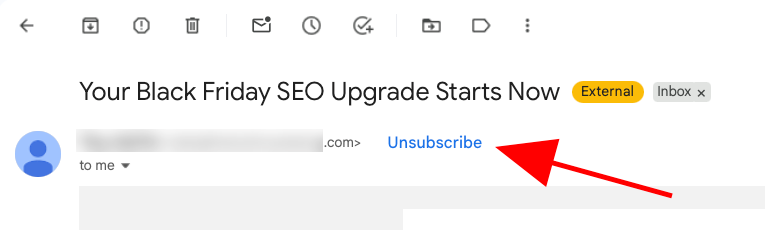
What goes around…
While your contacts can disconnect from you through an email unsubscribe, you have the same power if you happen to be on their list.
With most of my recent unsubscribes that I mentioned above, I quickly checked my email history to see if I was on their list. For the people I surmised are unlikely to buy from me in the future, and/or refer others to me, I pulled the trigger and unsubscribed from their lists.
I believe in the old maxim that actions speak louder than words. As a result, I wanted to send a signal to these contacts that: I see you bowing out from my content, and now I made the choice that I’m not going to hear from you, either. (Of course, that’s just the email channel — I didn’t also disconnect from or unfollow them on LinkedIn, for example.)
Am I being petty to do these digital “eye for an eye” actions? I don’t think so, for two reasons:
If my content is not resonating for someone and they made the (relatively speaking, in context) bold decision to opt out, then I’m probably not going to win them back. Which means they’re not my ideal client, and they self-selected to tell me that.
There are plenty of other contacts out there for whom my brand, messaging, and content does, and will, resonate. As a result, I can focus my time (and emotions) on getting more of those folks to join my email list, and on better satisfying those who do.
The question to ask yourself if you know a contact well who you’re considering unsubscribing from
Here it is:
Do I want to put up with getting more emails from them (which I can delete or set a filter to delete for me) versus sending a possible signal that I don’t like or appreciate them — in addition to their content — through an Unsubscribe click?
Note that I mentioned above that I took the reciprocal action of unsubbing from most — not all — email lists where the contact unsubbed from my list. In some cases, I decided that it’s a better longterm play to remain on an unsubber’s list and delete (or filter-delete) their future emails to me.
Tracking those who unsubscribe from your list helps you manage your time if they come out of the woodwork for a future need
In my mind, an unsub — from someone who double opted in and, therefore, at one point sent a strong signal that they want to hear from me — is a major factor for whether I need to spend time on any future requests from them, versus spending the same amount of time on another contact. In this way, the contact’s unsub action has the silver lining of doing me a favor when it comes to how I spend my time to make my business as successful as I can every day.
This tracking is easy to set up in several ways, depending on the CRM system you use (including features of Google Workspace or Outlook that can mimic the core functionality of a standalone CRM platform). If you use an email platform that’s tied to your website management platform, for example, you can monitor your subscriber count daily or weekly. For any drops, you can quickly identify them based on specific recent campaigns, and then change their Label status (e.g., “Cold Lead”) in your CRM, or delete them from it.
If you don’t use a dedicated CRM platform — which is perfectly fine, especially for newer and smaller businesses — you can also track them in a Google or Excel sheet that you’ve customized for your business (I include such a sheet, called Service-Market Fit, as part of my Virtual Networking 2 Leads System). In this sheet, you can simply de-mark a column labeled as “Warm Lead” and/or color-code the person’s contact row as red or another color that immediately tells you to focus on other rows (leads) instead of this person in your future marketing campaigns.
The bottom line
I wrote this post to help businesses deal with email list unsubscribes that are personal — yes, sometimes business is personal. Yet, my dual goal is to paint a picture of what it looks like on the other side of the internet connection, for business owners who do everything from a random, “this is not for me today” unsub action to a “whole house,” Marie Kondo-style purge of multiple email lists in a single session.
The next time you want to reduce the “clutter” in your inbox, consider your connections to the people whose lists you joined. If you tend to work with — and send/receive referrals from — solopreneurs and small business owners, it’s a good practice to not just look at that tempting Unsubscribe link, but at the Sender Name, and to ask yourself if you really want to send one of the strongest signals in marketing: opting out forever.
